

Workshop Title:
“Beyond Expansion: Why Interpreter Education Needs a New Framework”
Workshop Description:
For thirty years, Lawrence’s expansion techniques have shaped how interpreter educators teach ASL discourse features and how practitioners evaluate their work.
I will argue that Lawrence’s term expansion should be abandoned. The presentation offers three reasons and a replacement framework from cognitive grammar and translation studies. First, Lawrence never formally defined expansion. Across three publications (1994, 2003, 2007), each offered a different characterization, and practitioners have treated expansion as permissible content addition, despite Lawrence’s observation that ASL does not require “more information.” Second, Lawrence’s own abstract names them “techniques that are used by native signers” (1994, p. 205), yet the framing around interpreter competence and the 2007 introduction of compression invite the reading that these are interpreter strategies. They would be more accurately framed as discourse features language learners should incorporate into their ASL production. Third, expansion does not describe what the features are doing to meaning.
Cognitive grammar (Langacker, 2008) reframes them as construal operations — ways of accessing and attending to conceptual content rather than additions to it. Some features surface implicit source content, a process called explicitation (Vinay & Darbelnet, 1958/1995), while others, such as reiteration, do not. The presentation closes with recommendations for interpreter and ASL educators.
Educational Objectives:
After attending this presentation, participants will be able to:
1) Distinguish between a construal shift and a content addition when analyzing an interpreted text.
2) Apply the construal framework to at least one of Lawrence’s seven features (e.g., contrasting) to describe what it is doing to meaning rather than to content.
3) Differentiate between features that make implicit source-text content linguistically explicit (explicitation) and features that do not (e.g., reiteration).
4) Explain why framing the seven features as interpreter “techniques” is misleading.
5) Describe how reframing the features as ASL discourse features changes the way an educator would introduce them to learners.
Bio:
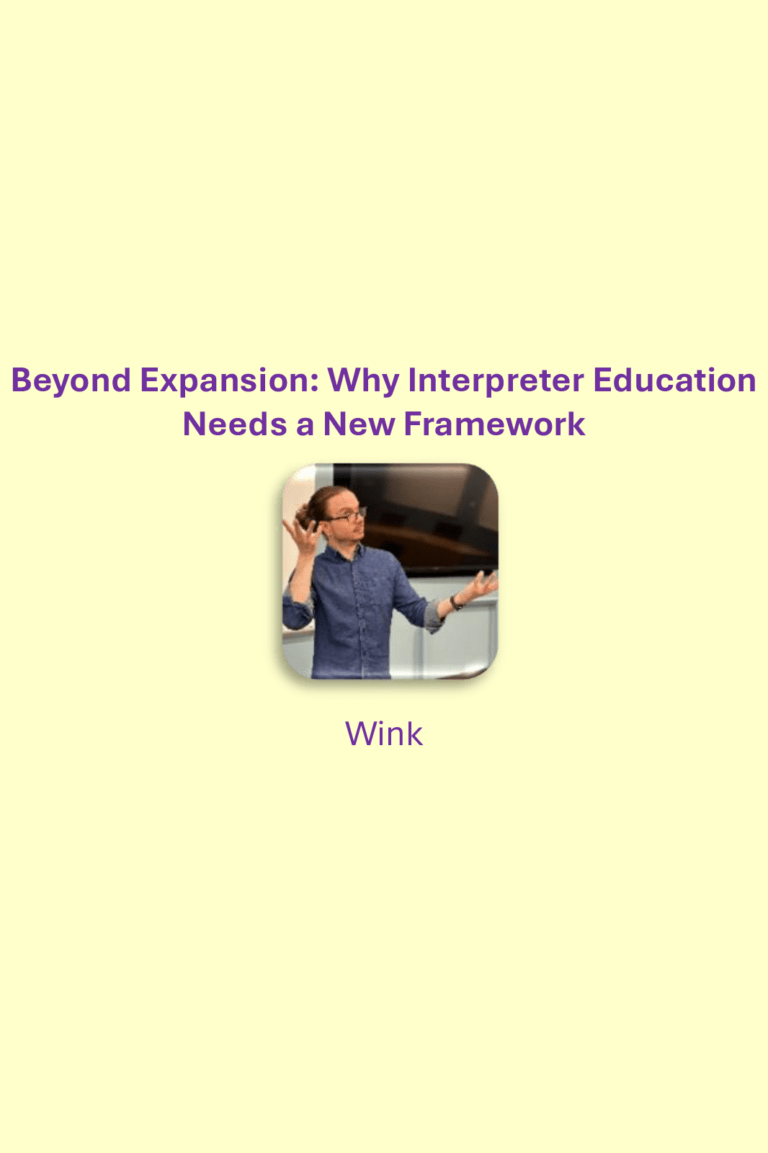
Wink, PhD, NIC-Master, is an interpreter, educator, and researcher with over twenty years of professional interpreting and translation experience and over fifteen years in instruction and research. He has presented nationally and internationally, including at NAD and RID conferences, and published on deliberate practice in RID Views. He has served on RID’s Certification Council, held a board position with CIT, and received the NAD Outstanding Service to Interpreting Award in 2016. To date, he has delivered over 2,800 hours of live CEU training.
As an assistant professor in Interpretation and Translation at Gallaudet University, Wink teaches undergraduate and graduate students, encouraging future change agents in the field. His research explores depiction in interpretation, redefines traditional notions of expansion and equivalence, and is grounded in a cognitive linguistic framework. He has also developed translated tours for the U.S. Capitol and the Sixth Floor Museum in Dallas.
RID CEUs Offered: .15