Workshop Title:
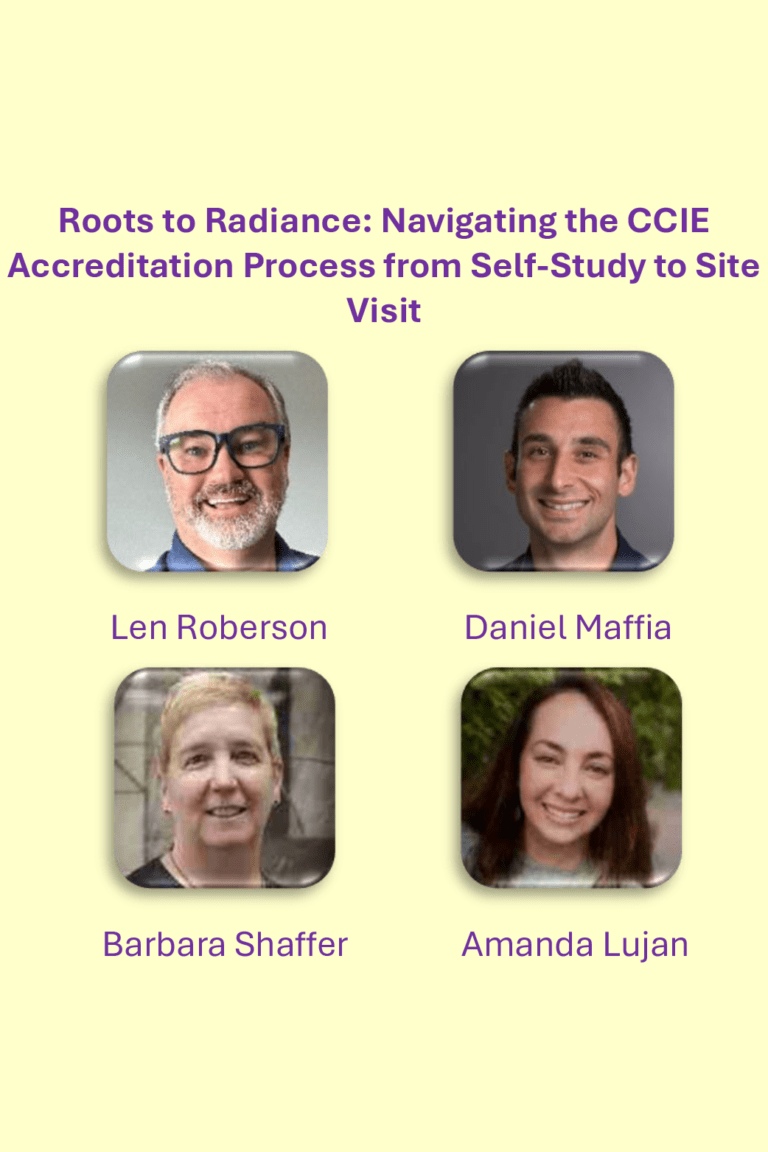
“Roots to Radiance: Navigating the CCIE Accreditation Process from Self-Study to Site Visit”
Workshop Description:
This session offers a practical and transparent exploration of the CCIE accreditation process, guiding participants from initial application through self-study development and site visit preparation. Aligned with the conference theme “Roots to Radiance,” the session frames accreditation as a developmental journey—grounded in foundational program practices and culminating in evidence-based quality, accountability, and continuous improvement.
Participants will gain a clear understanding of each phase of the accreditation process, including eligibility, application submission, peer review, and ongoing improvement cycles. The session will highlight effective strategies for conducting a comprehensive self-study, including approaches for aligning curriculum with standards, documenting student outcomes, and demonstrating commitment to Deaf-centered and culturally responsive practices.
Particular attention will be given to commonly challenging areas such as assessment systems, faculty qualifications, and evidence of program effectiveness. The session will also explore how digital tools and collaborative platforms can support efficient documentation and communication.
Attendees will leave with concrete strategies and increased confidence to initiate or strengthen their program’s path toward accreditation.
Educational Objectives:
By the end of this session, participants will be able to:
1) Describe the major phases of the CCIE accreditation process in correct sequence.
2) Identify at least three effective strategies for organizing and completing a self-study report aligned with CCIE Standards.
3) Analyze two commonly challenging areas of the accreditation standards and describe corresponding evidence or documentation strategies.
4) Develop a preliminary action plan (including at least three steps) for initiating or advancing an accreditation process within their own program.
Bio:
Len Roberson, PhD, has been involved in the field of interpreting for over 35 years. He is the program director of the ASL/English interpreting program at the University of North Florida, and an active researcher, interpreter, and interpreter educator. He is a certified Master Reviewer with Quality Matters, a certified Master Online Teacher, and has ACUE certification in Effective Teaching Practices. His current research interests include admissions screenings and curriculum and accreditation of interpreter education programs, and online teaching and learning. He is the current President of CCIE and editor for the Journal of Interpretation, published by RID.
Daniel Maffia is the Practicum and Community Coordinator and a principal lecturer with the department of American Sign Language and English Interpreting Department’s Interpreter Education Program at the National Technical Institute for the Deaf, teaching at both the Bachelor’s and Master’s degree levels. He obtained his bachelor’s degree in Interpreting at the Rochester Institute of Technology in 2009. In 2010, he became certified, and in 2014 earned his Master’s in Interpreting Studies with an emphasis in Teaching Interpreting from Western Oregon University. Daniel served as a staff interpreter in the Department of Access Services at the Rochester Institute of Technology. Daniel continues interpreting as a video and community interpreter. Daniel is the co-author of the Introduction to VRS Curriculum Guidebook. He is currently the Vice President of CCIE. Daniel’s research interests relate to reflective practice, Demand-Control Schema, and self-care in which he presents workshops for interpreters nationally and internationally.
Dr. Barbara Shaffer (RID: SC:L CI/CT, NAD-V) is a Professor in the Signed Language Interpreting Program in the Department of Linguistics at the University of New Mexico. Dr. Shaffer’s research interests include the grammaticalization of signed languages, stance markers in American Sign Language, intersubjectivity in discourse, and intersubjectivity in interpreted interactions. With her colleague, Terry Janzen, Barb recently published the volume Signed Language and Gesture Research in Cognitive Linguistics. She and Dr. Janzen are currently finishing up a book entitled Intersubjectivity in Interpretation: A Cognitive View of Interpreter-Mediated Discourse.
Amanda Luján, M.S., NIC (CCIE Commissioner and Treasurer) – Amanda is the Director for Development and Community Relations at the New Mexico School for the Deaf (NMSD). Previously, she taught undergraduate courses for nine years and was the Director during the 2024-2025 academic year for the University of New Mexico’s (UNM) Signed Language Interpreting Program. She earned her M.S. degree in Interpreting Pedagogy from the University of North Florida in 2013 and is currently pursuing her doctoral degree in Educational Linguistics at UNM. She also previously worked as the Coordinator of Interpretation and Translation Services at NMSD. Amanda has 20 years of experience as an interpreter practitioner in various settings. She also currently serves on the NM Mano a Mano Board helping to create professional development opportunities for trilingual interpreters and is the CEU Chair for the 2026 CIT Conference.