Workshop Title:
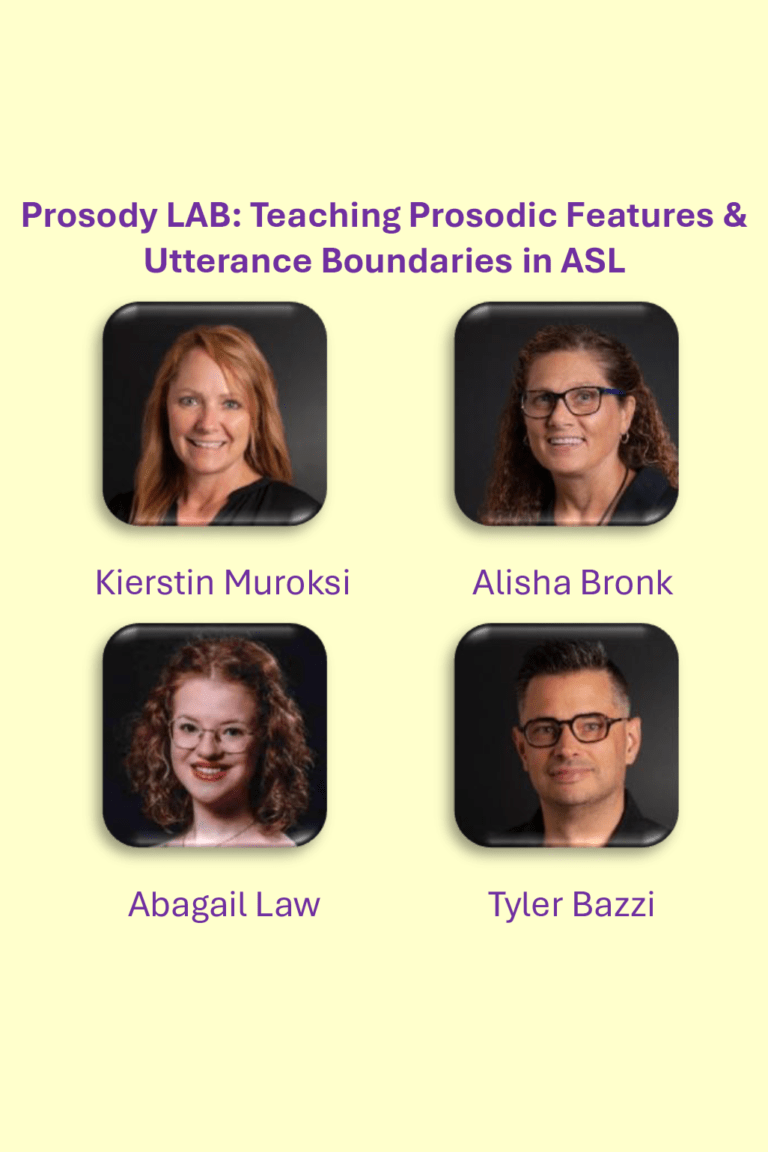
“Prosody LAB: Teaching Prosodic Features & Utterance Boundaries in ASL”
Workshop Description:
Many ASL learners and interpreting students can understand individual signs—but struggle to see how those signs come together to form complete idea segments. When utterance boundaries (the natural breaks between ideas) are missed, meaning can quickly become unclear or inaccurate. This interactive session focuses on helping students see how ASL is organized. We’ll explore prosodic features—timing, facial expressions, head and body movement—and how they signal meaning and structure in real time.
Educational Objectives:
Participants will work through real ASL examples, uncover common learner mistakes, and walk away with simple, practical strategies they can use right away in their teaching or mentoring.
You will also get hands-on experience with ProsodyLab, a browser-based training tool designed to build students’ ability to recognize utterance boundaries while watching ASL.
If you’re looking for a clear, practical way to help students move from “seeing individual signs” to “understanding idea chunks,” this session will give you tools you can use immediately! By the end of this session, participants will be able to:
1) Identify selected prosodic features in ASL that may signal utterance boundaries.
2) Recognize how missed utterance boundaries can affect students’ comprehension and interpretation accuracy.
3) Describe one or two practical ways to use ProsodyLAB to support students’ boundary-recognition skills.
Bio:
Dr. Kierstin Muroski is the director of the Research in Interpreter and Translator Education (RITE) lab and an Assistant Professor in the Department of American Sign Language Interpreter Education at the National Technical Institute of Technology (NTID) at the Rochester Institute of Technology (RIT). She holds an MA and PhD in Interpretation and Translation from Gallaudet University and has over 25 years of experience teaching interpretation, translation, and linguistics; developing curriculum; aligning course coherence and assessment; and researching the fields of linguistics, translation, and interpretation. Before teaching at NTID, Dr. Muroski served as program coordinator, instructor, and curriculum developer for the ASL-English Interpreting programs at Mount Aloysius College and Bloomsburg University, where she designed the curricula and spearheaded six national student-run interpreting conferences. She is a nationally certified interpreter who has presented at national and international conferences in her field.
Alisha Bronk, a Deaf Interpreter with over thirty years of experience, is dedicated to advancing the fields of American Sign Language and International Sign. She obtained her master’s degree in applied Linguistics from Portland State University in 2009. Currently, she is a full-time faculty member in the ASL and Interpreting Education Department at the Rochester Institute of Technology’s National Technical Institute for the Deaf (RIT/NTID), where she also holds the position of coordinator for the Certification in Deaf Interpreting (CIDI) hybrid courses. As a dynamic and enthusiastic educator, Alisha is committed to enhancing her students’ understanding through visual and spatial representation. She frequently conducts workshops aimed at improving sign language skills in innovative 5D formats. Outside of her professional pursuits, Alisha enjoys hiking and traveling, and she values spending quality time with her family to create lasting memories. Abagail Law is a first-year undergraduate student at the National Technical Institute for the Deaf (NTID) at the Rochester Institute of Technology studying ASL-English Interpretation and Psychology. As a research assistant under Dr. Kierstin Muroski in the RITE Lab (Research on Interpreter and Translator Education), she helps conduct Think Tanks and weekly Research Roundtables. She also contributes to the maintenance and development of the InterpNET website. She presented a research poster at the 2026 NTID Student Research Fair. She is passionate about interpreting and language learning, and looks forward to her remaining years at RIT/NTID.
Abagail Law is a first-year undergraduate student at the National Technical Institute for the Deaf (NTID) at the Rochester Institute of Technology studying ASL-English Interpretation and Psychology. As a research assistant under Dr. Kierstin Muroski in the RITE Lab (Research on Interpreter and Translator Education), she helps conduct Think Tanks and weekly Research Roundtables. She also contributes to the maintenance and development of the InterpNET website. She presented a research poster at the 2026 NTID Student Research Fair. She is passionate about interpreting and language learning, and looks forward to her remaining years at RIT/NTID.
Tyler Bazzi is a lecturer in NTID’s ASL and Interpreting Education department. He has taught ASL for 13 years in a range of settings: high school world language classrooms, a bilingual-bicultural residential school for the deaf, and college. As an NTID student, he co-founded No Voice Zone with a few classmates, an informal ASL class for incoming hearing freshmen in the residence halls that recently celebrated its 25th anniversary. Tyler holds a bachelor’s degree from RIT and a master’s in Deaf Education from Texas Woman’s University, and is completing an MBA at RIT. He is interested in how organizational behavior applies in education, including team dynamics in Deaf organizations, interpreter working relationships, and the dynamics between faculty and students. He is also exploring the use of AI in tutoring, assessment, and feedback.
RID CEUs Offered: .15