
Workshop Title:
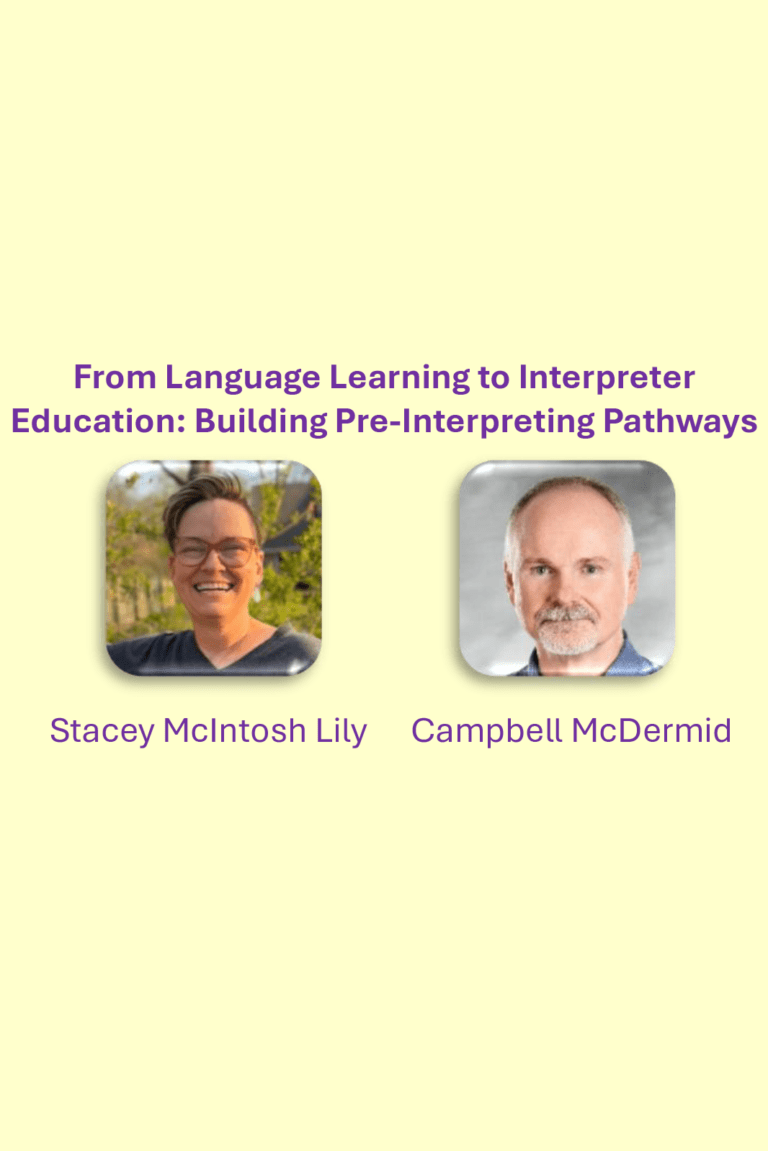
“From Language Learning to Interpreter Education: Building Pre-Interpreting Pathways”
Workshop Description:
This interactive seminar explores two distinct but complementary approaches to preparing students for interpreter education: a pre-translation Associate of Arts degree at Gallaudet University and a Pre-Interpreting minor at the University of Kansas. While these programs differ in structure and context, both are grounded in a shared commitment to strengthening language foundations and supporting student readiness prior to formal interpreting coursework.
Presenters will briefly share the rationale and design considerations behind each program, including how language development and sequencing of learning experiences inform their approaches. The session will then shift to guided discussion, inviting participants to reflect on their own program contexts and consider key questions related to preparation and readiness.
Together, participants will explore the distinction between language learning and learning to interpret, examine areas of overlap, and consider what knowledge, experiences, and competencies may be most critical prior to entering interpreter preparation. Through dialogue and small group exchange, attendees will have the opportunity to share strategies, challenges, and perspectives, contributing to a broader conversation about how programs can more intentionally support students before they begin learning to interpret.
Educational Objectives:
By the end of this session, participants will be able to:
1) Examine how their own programs approach the relationship between language learning and interpreting education.
2) Reflect on how current structures within their programs support or limit student readiness prior to entering interpreter education.
3) Consider potential adjustments or strategies that could strengthen language development and preparation before students begin interpreting coursework.
Bio:
Stacey McIntosh-Lily was born and raised in Colorado. They carry deep gratitude for their sister, Drei, their parents who chose to learn and use sign language, and the Deaf and interpreting communities in Greeley and Denver that have shaped who they are today.
Now based in Overland Park, Kansas, Stacey serves as Program Director and Professor of the Practice in the ASL & Deaf Studies and Interpreting program at the University of Kansas Edwards Campus. Their work centers on building meaningful connections between students, community, and practice, with a focus on collaboration, growth, and real-world application.
Stacey remains actively engaged in interpreting and often shares that the day they stop interpreting is the day they stop teaching.
Outside of work, Stacey is a proud “Noni” to their grandson and enjoys learning the game of pickleball.
Dr. Campbell McDermid is a Professor in the Department of Interpretation and Translation at Gallaudet University and a nationally certified ASL–English interpreter. He has been publishing scholarly work continuously since 2000 and has authored or co-authored 25 peer-reviewed journal articles and conference proceedings and 4 peer-reviewed book chapters, with one in press, in addition to two scholarly books. Dr. McDermid’s research investigates sign language interpreting and translation with a focus on models of interpreting, pragmatics, the Explicitation theory, interpreter education and pedagogy, social annotation and technology-enhanced learning, gender and identity in interpreting, Deaf interpreter experiences, fingerspelling, and cohesion and meaning-making. His work also addresses equity-centered themes such as audism, allyship, resilience, and professional socialization within interpreter training programs.
Methodologically, his scholarship reflects strong expertise in qualitative and mixed-methods research, including thematic and inductive coding, case study designs, pragmatic analysis, and small-scale quantitative studies. His work focuses on the integration of applied research and pedagogical innovation in interpreter education as he utilizes his research findings in his instruction.
RID CEUs Offered: .15