
Workshop Title:
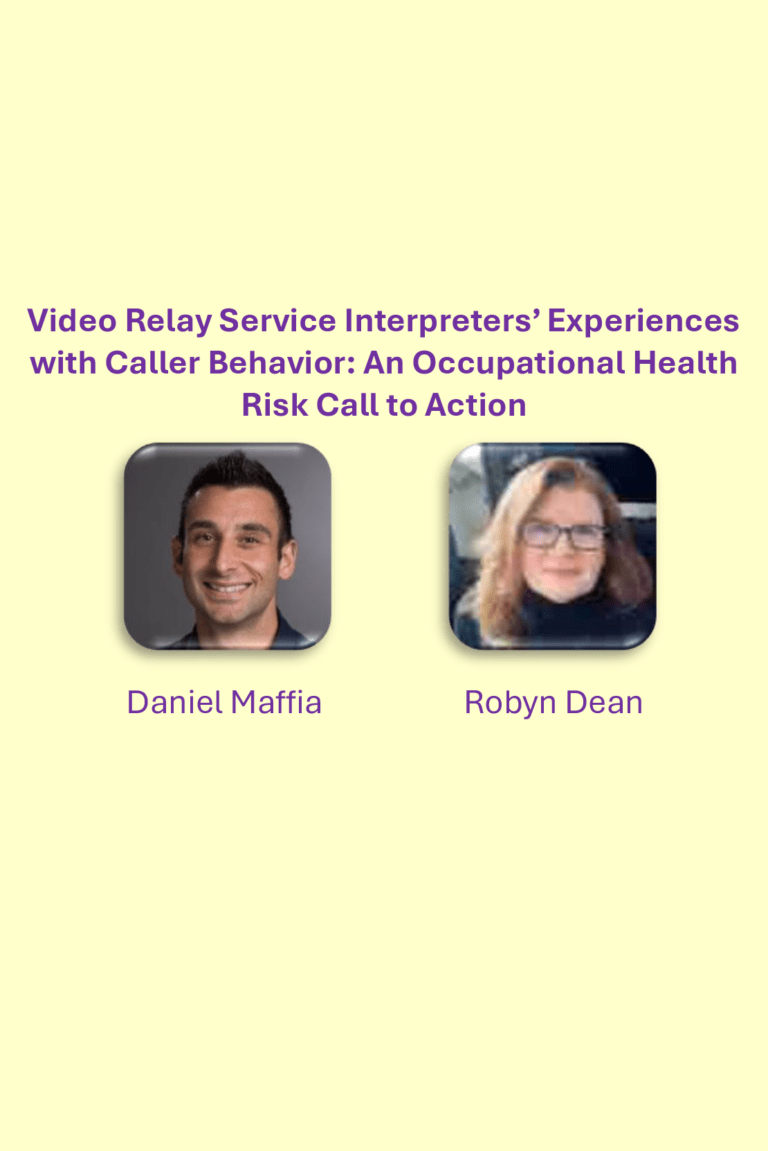
“Video Relay Service Interpreters: Experiences with Caller Behavior: An Occupational Health Risk Call to Action”
Workshop Description:
Video Relay Service (VRS) is a common employment setting for interpreters, yet it exposes practitioners to unique occupational risks that are often underrepresented in interpreter education and workplace training. This session presents findings from a mixed-methods study examining VRS interpreters’ experiences with caller behavior, including exposure to sexually explicit content, abusive interactions, and potentially illegal activities.
Participants will explore how these experiences impact interpreter well-being, decision-making, and career sustainability. The session will highlight the disconnect between the realities of VRS work and the preparation many students receive in training programs.
Building on these findings, the presentation will focus on the role of interpreter educators in addressing this gap. Attendees will be introduced to practical strategies for incorporating discussions of occupational risk, ethical complexity, and workplace conditions into their teaching. Emphasis will be placed on preparing students to make informed choices about their career pathways and to enter the workforce with a clearer understanding of VRS demands.
This session is designed for interpreter educators seeking to align curriculum with real-world practice and better support the next generation of interpreters.
Educational Objectives:
By the end of this session, participants will be able to:
1) Identify common types of high-risk caller behaviors encountered in VRS settings, including exposure to explicit, abusive, and potentially illegal content.
2) Explain the occupational health implications of VRS work, including stress, burnout, moral distress, and reduced autonomy.
3) Analyze how organizational policies and regulatory frameworks contribute to or mitigate risk in VRS interpreting environments.
4) Evaluate current gaps in interpreter education related to preparing students for VRS work.
5) Apply strategies for integrating VRS-specific risk awareness and informed decision-making into interpreter training curricula.
Bio:
Daniel Maffia is the Practicum and Community Coordinator and a principal lecturer with the Department of American Sign Language and English Interpreting Department’s Interpreter Education Program at the National Technical Institute for the Deaf, teaching at both the bachelor’s and master’s degree level. He obtained his bachelor’s degree in Interpreting at the Rochester Institute of Technology in 2009. In 2010, he became certified, and in 2014 earned his Master’s in Interpreting Studies with an emphasis in Teaching Interpreting from Western Oregon University. Daniel served as a staff interpreter in the Department of Access Services at the Rochester Institute of Technology. Daniel continues interpreting as a video and community interpreter. Daniel is the co-author of the Introduction to VRS Curriculum Guide book. He is currently the Vice President of CCIE. Daniel’s research interests relate to reflective practice, Demand-Control Schema, and self-care, for which he presents workshops for interpreters nationally and internationally.
Robyn K. Dean, CI/CT, PhD has been a nationally certified signed language interpreter for over thirty-five years with particular service in the field of healthcare. Her scholarship in decision-making and ethics in community interpreting is recognized internationally. Dr. Dean has over twenty publications, all of which focus on the theoretical and pedagogical frameworks used to advance the practice of community interpreters. Dr. Dean is currently an Associate Professor at the Rochester Institute of Technology, where she is the lead instructor on the Institute’s postgraduate degree in healthcare interpretation.
RID CEUs Offered: .15