Workshop Title:
“Human by Design: Promoting Interpreter Education for the Age of AI”
Workshop Description:
AI is already changing how we work, communicate, and access information. What happens when it begins doing more of the work interpreters do? What if sign language recognition (SLR) by artificial intelligence (AI) becomes comparable to the receptive skills of most interpreters? Using “nested contexts” – think of Russian matryoshka dolls where each doll fits neatly inside a slightly larger one – this presentation looks beyond individual interpreter performance to explore historical trends and the larger social environment surrounding interpreted interaction. Is AI our competitor? Our Partner? Both? The AI challenge opens up the social situations in which interpreting occurs, inviting the members of CIT to make a fresh, proactive contribution to today’s intersectional challenges. We introduce CoSET S.A.F.E. AI, a think tank devoted to upholding the integrity of communication during interpreted interaction. Rather than simply asking whether AI will change interpreting, CoSET S.A.F.E. AI asks: How can interpreter educators help shape that change? The field needs tools to strengthen cognitive skills for interpreters and also primary communicators, both h/Hearing and Deaf. These tools build competence for the range of ‘moves’ and ‘turns’ possible during interpreted interaction. On the basis of accumulated professional wisdom, interpreter educators can inform and guide the ways that AI interpreting is distributed through society.
Educational Objectives:
Participants will be able to:
1) Define the concept of “nested contexts” using at least one example across three or more levels of ‘nesting’
2) Illustrate an example of how shifts among or across nested contexts affect the cooperation required among primary communicators and interpreter(s)
3) Analyze an interpreted interaction for the range of possible “moves” and “turns” available to participants
Bio:
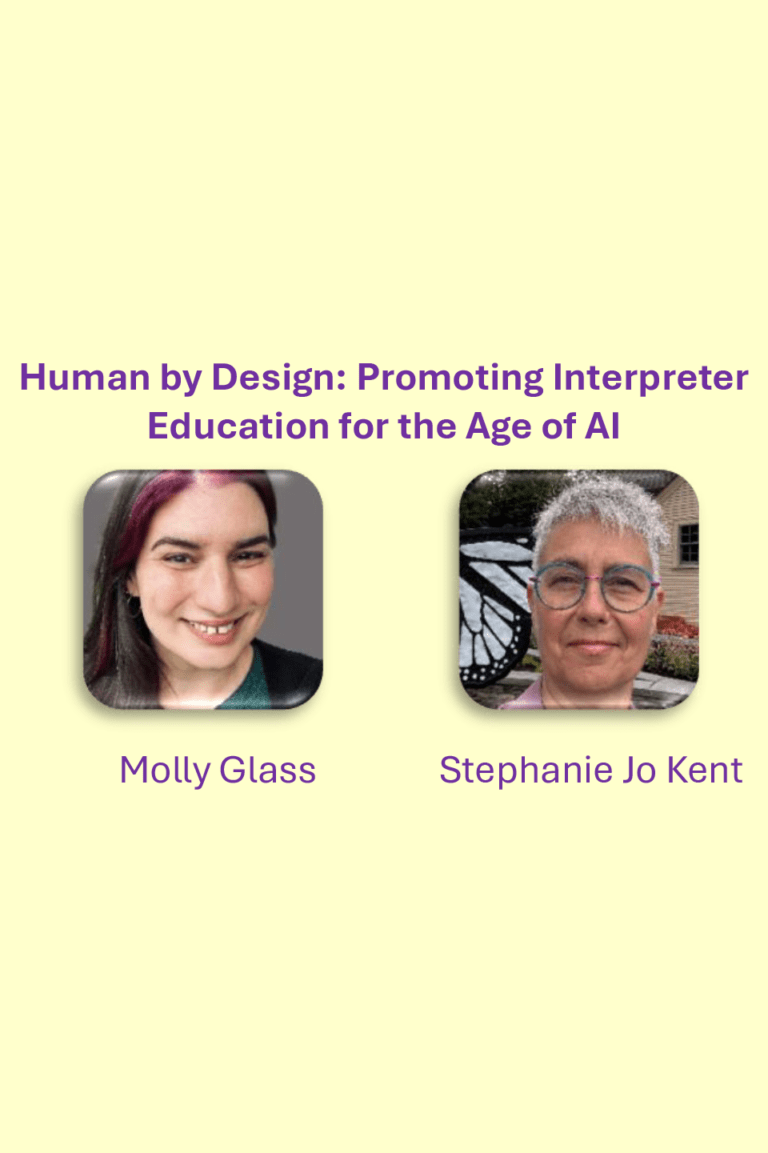
Stephanie Jo Kent, CI, PhD. Steph, an ethnographer and interpreter, believes interpreted interaction works best when the conditions are designed for people—not just technology. Her action research explores how languages, cultures, and AI can strengthen the integrity of communication by supporting human collaboration among equals, enabling understanding to flow both ways.
Molly Glass is a Deaf Interpreter, ASL Project Coordinator, and advocate with expertise in AI and hybrid driven sign language translation. As a member of the CoSET Leadership Circle, she works to ensure emerging technologies are designed with Deaf communities through ethical, inclusive, and language-first practices.
Motto: Good things take time. If something is worthwhile, it’s worth the effort and patience to get there.
RID CEUs Offered: .15