
Workshop Title:
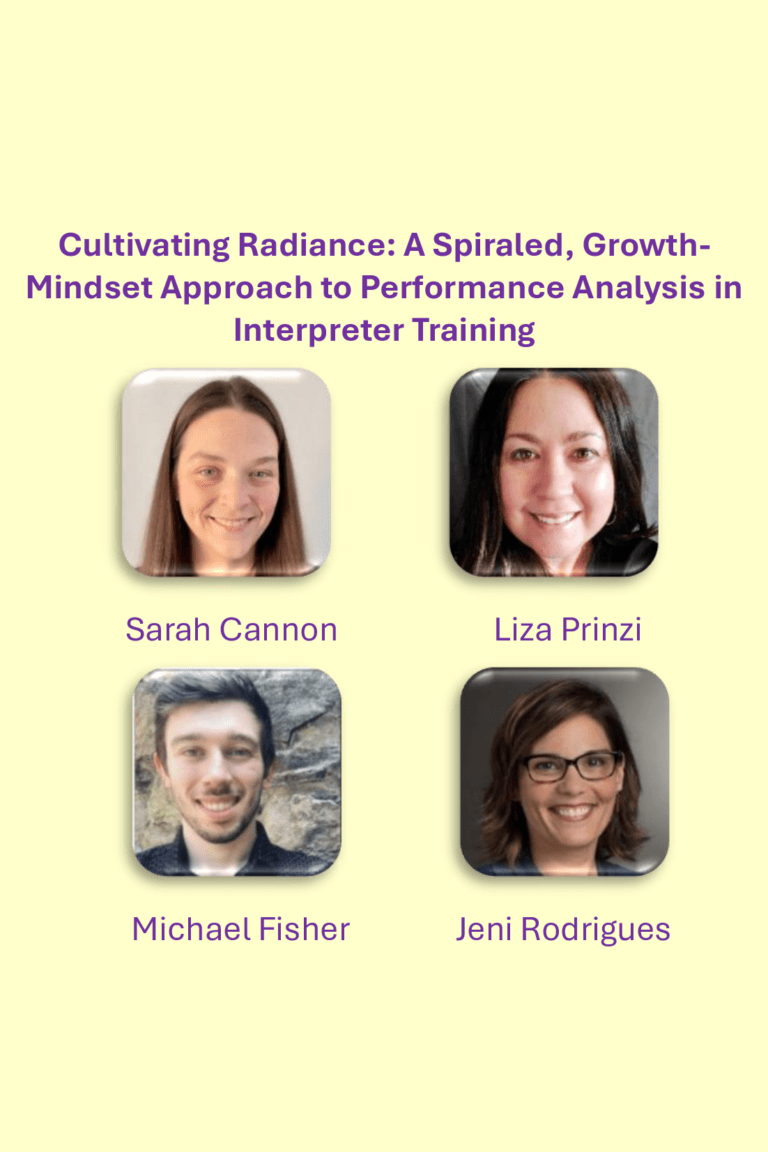
“Cultivating Radiance: A Spiraled, Growth Mindset Approach to Performance Analysis in Interpreter Training”
Workshop Description:
For more than four decades, the Department of American Sign Language and Interpreting Education (ASLIE) at the National Technical Institute for the Deaf (NTID) has played a leading role in developing and refining performance-analysis and feedback pedagogies in interpreter education. This presentation examines ASLIE’s spiraled framework for performance analysis and its intentional use across the curriculum to support students’ development of reflective, collaborative, and dialogic practices.
The spiraled model conceptualizes analysis not as evaluative judgment, but as a structured, developmental practice that evolves alongside students’ interpreting skills and metacognitive capacity. Faculty will describe how analytic practices are purposefully scaffolded from Processing Skills Development through upper-level interpreting courses, beginning with self-analysis grounded in a growth-mindset framework and expanding to peer and whole-class analytical dialogue.
The presentation highlights a structured peer-feedback activity implemented in Interpreting II and III that adapts key principles from Think-Aloud Protocol (TAP) research to make analytic reasoning explicit. Preliminary implementation data, including student reflections, will be shared alongside observed benefits and challenges. Participants will engage in hands-on practice with the model and leave with a replicable framework, sample analytical prompts, and practical strategies for facilitating constructive peer dialogue across interpreter education programs.
Educational Objectives:
Upon completion of this workshop, participants will be able to:
1) Describe ASLIE’s spiraled performance analysis framework — including the Glows, Grows, Grants, and Grit growth-mindset model — and explain how it scaffolds reflective practice from Processing Skills through Practicum.
2) Distinguish between Think-Aloud Protocols as self-directed metacognitive tools and structured peer observation as a dialogic feedback practice, and articulate the pedagogical rationale for sequencing them appropriately.
3) Identify at least three research-based analytical categories drawn from TAP literature (Russell & Winston, 2014; Smith, 2014) that can be used to guide structured peer observation in interpreting courses.
4) Apply a replicable classroom model for facilitating constructive peer dialogue about interpreting work samples, as practiced during the interactive component of the session.
5) Analyze the benefits and challenges of implementing spiraled, peer-mediated performance analysis across multiple courses in an interpreter education program, drawing on ASLIE’s preliminary implementation data.
Bio:
Sarah Cannon, MS, is a nationally certified sign language interpreter with nearly 30 years of professional experience, primarily in K–12 and post-secondary settings. She is a full-time lecturer at the National Technical Institute for the Deaf (NTID) in the American Sign Language and Interpreting Education (ASLIE) Department. Sarah teaches interpreting skills courses with an emphasis on consecutive and simultaneous interpreting, and she facilitates a practicum seminar for senior students. She served as a project liaison for ASLcore.org, an online resource that brought Deaf content experts and native ASL users together to create discipline-specific ASL content across post-secondary fields such as chemistry, philosophy, art, and biology. This work reflected a strongly Deaf-centered, collaborative approach to developing rich, accessible resources for ASL users, learners, and interpreting professionals. Sarah is deeply committed to mentoring students, supporting their skill development, and fostering meaningful connections in the community.
Lisa Prinzi, Ph.D., is an Assistant Professor in ASL and Interpreting Education at NTID, where she teaches core interpreting skills in the bachelor’s and CEI programs. A former K–12 educational interpreter, her research focuses on deaf students’ and interpreters’ experiences in mainstream settings, with work published in the Journal of Deaf Studies and Deaf Education, including studies on interpreter–student relationships, positioning in K–12 classrooms, and critical mass in mainstream programs. She presents nationally on performance analysis, collaboration, and educational interpreting practices that support deaf students’ autonomy, linguistic identity, and equitable access.
Michael Fisher, MA, is a nationally certified interpreter, educator, and mentor whose work centers on cultivating reflective, growth-oriented learning environments in interpreter education. He is a full-time lecturer at the National Technical Institute for the Deaf (NTID) and has mentored student and novice interpreters across academic, community, and organizational settings. As the former mentorship chair for the New York City Metro Registry of Interpreters for the Deaf, he designed and launched the inaugural cohort of the Connection Network, pairing novice and certified interpreters for structured practice, feedback, and reflective dialogue. Since relocating to Rochester in 2023, he has continued his service to the field as Vice President for the Genesee Valley Region RID.
Jeni Rodrigues, PhD, is an Assistant Professor in the Department of ASL and Interpreting Education at the National Technical Institute for the Deaf at Rochester Institute of Technology, where she also coordinates the Certificate in Healthcare Interpreting program. With over 25 years of interpreting practice, including a decade of specialization in healthcare settings, Jeni brings both practitioner expertise and scholarly inquiry to her teaching. She earned her master’s in Interpreting Pedagogy from Northeastern University (2011) and her PhD in Interpreting from Gallaudet University (2022). Her research explores access barriers deaf patients encounter in healthcare settings, best practices in ASL-English healthcare interpreting education, and the experiences of neurodivergent interpreters. Committed to equity in interpreter education, Jeni actively mentors emerging scholars, including supervising student research on race-conscious teaching practices, reflecting her broader investment in anti-racist and anti-ableist pedagogy.
RID CEUs Offered: .15