Workshop Title:
“From Roots to Radiance: Cultivating Communities of Practice in ASL/English Interpreter Education”
Workshop Description:
ASL/English Interpreter Education is a developing field rooted in community-driven, practice- based traditions rather than long-established academic frameworks. While these origins emphasize mentorship, collaboration, and relational learning, they also present ongoing challenges, including limited research, inconsistent pedagogical training, and professional isolation among educators. Many instructors enter the classroom with strong interpreting experience but minimal preparation in teaching methodologies, curriculum design, and assessment. This interactive workshop invites participants to honor these roots while cultivating new pathways for growth and sustainability. Centered on the development of a community of practice, the session provides a collaborative space for ASL interpreter educators to reflect, share strategies, and co-construct knowledge grounded in lived experience. Participants will explore approaches to strengthening instructional practices, supporting novice interpreter development, and integrating mentorship and peer collaboration into their programs. Through guided discussion and practical activities, attendees will identify common challenges and generate actionable strategies adaptable to diverse educational contexts. Drawing from a 15-week mentoring cohort of interpreter educators, this workshop highlights the transformative potential of collective learning. Participants will leave equipped with tools and frameworks to foster connection, enhance teaching effectiveness, and contribute to a more cohesive and sustainable future for the field.
Educational Objectives:
Participants will be able to:
1) Identify key challenges within ASL/English Interpreter Education, including gaps in pedagogical preparation, limited resources, and barriers to consistent curriculum development.
2) Analyze the role of small-group mentoring in supporting educator growth, improving teaching efficacy, and addressing competency gaps among novice interpreters.
3) Apply collaborative strategies to enhance curriculum design, instructional practices, and student skill development within a bilingual, bimodal learning environment.
4) Evaluate the value of communities of practice as a mechanism for reducing professional isolation and fostering sustained educator collaboration and knowledge-sharing.
5) Develop an actionable plan to implement mentoring structures and/or communities of practice within participants’ own institutional or professional contexts.
Bio:
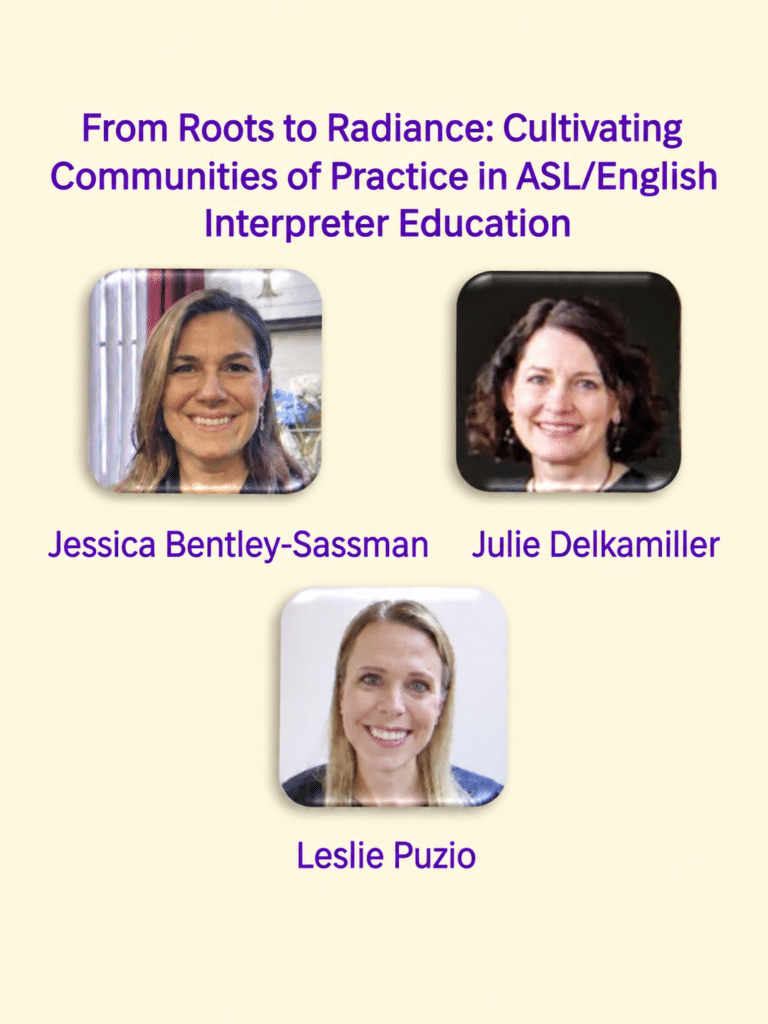
Jessica Bentley-Sassaman, Ed.D., is a Professor of ASL/English Interpreting at Commonwealth University of Pennsylvania: Bloomsburg. Jessica earned her bachelor’s from Bloomsburg University in Interpreting for the Deaf and Hard of Hearing, her Master of Arts from Gallaudet University in Linguistics, and a Doctoral Degree in Education from Walden University. Her doctoral study was focused on Deaf and hearing interpreter teams and the teamwork aspect of their work. She has earned her CI, CT, and SC:L from RID and holds the ED: K-12 as recognized by RID. She is a master certified interpreter through the Administrative Offices of the Pennsylvania Courts’ legal interpreter program. She interprets in various settings such as legal, government, and religious. Jessica has published articles related to mentoring and Deaf-hearing interpreter teams and has presented workshops on several topics.
Leslie Puzio, Ed.D., NIC, EIPA, is an Associate Professor at Frederick Community College in Frederick, Maryland. She teaches in the ASL Interpreter Program and has previously served as the Program Manager since its inception in 2017. Dr. Puzio has over 21 years of professional interpreting experience and over 12 years of mentoring and teaching experience. She earned her Doctorate in Educational Leadership, and her dissertation focused on accessibility and belonging. She currently serves on the Maryland State Board of Sign Language Interpreter Licensure. Her current research and area of focus are on advancing standardization among Interpreter Education Programs.
Julie Delkamiller, Ed.D., CI/CT, is currently an associate professor at the University of Nebraska at Omaha, training individuals to be teachers of the Deaf/Hard of Hearing and/or sign language interpreters. She holds a doctoral degree in Educational Leadership, a master’s degree in Learning Disabilities, and a bachelor’s degree in Deaf Education/Social Sciences. Julie previously taught secondary students at the Iowa School for the Deaf and has interpreted in academic, religious, video relay, and theatre settings.
RID CEUs Offered: .15