Workshop Title:
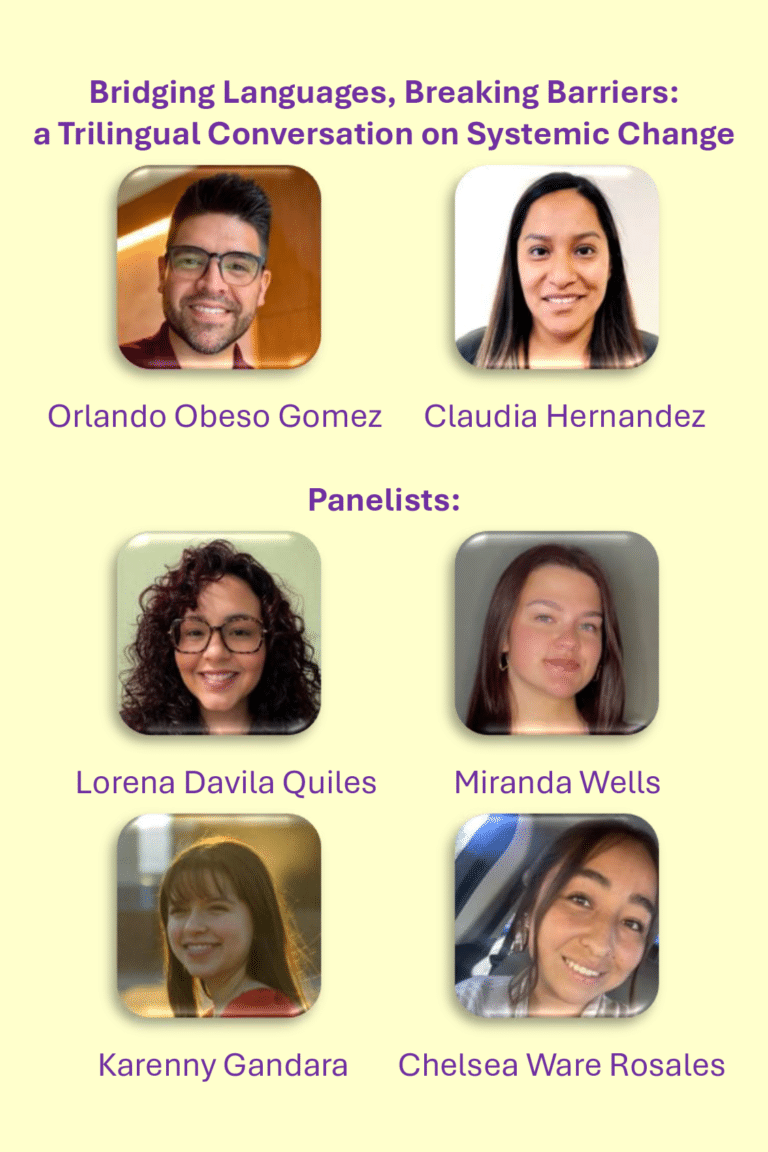
“Bridging Languages, Breaking Barriers: A Trilingual Conversation on Systemic Change”
Workshop Description:
The demand for trilingual interpreters is growing at a surprising rate and yet the infrastructure to support this demand is yet to be seen. In 2023 the RID Annual Report stated to have 13,253 interpreters in their registry. In 2026, through a query on their registry, 315 interpreters claim “Trilingual” under “Additional Language or Specialties”, yet only 26 interpreters hold a Board for the Evaluation of Interpreters (BEI) trilingual certification. Through this panel presentation participants will learn about the experiences of working interpreters and one student interpreter as they transitioned from their interpreter education programs and into the field of trilingual interpreting. They will recount their biggest hurdles in their preparation programs as well as the most challenging aspects of working as a trilingual interpreter with a varying degree of experience in the field upon graduation. They will identify the most useful experiences in their transition to work and collectively brainstorm on what a trilingual interpreter training program would potentially entail and the impact it would have on their professional trajectories.
Educational Objectives:
RID CEUs Offered: .15
Bios:
Orlando Obeso Gomez is a nationally certified (RID NIC and BEI Trilingual: Advanced) sign language interpreter working as a trilingual (Spanish/ASL/English) staff interpreter at the New Mexico School for the Deaf in Santa Fe, New Mexico. Orlando is a first-generation American and proud son of Mexican immigrants. This rich heritage, as well as the diverse culture of New Mexico, has contributed to his development as a trilingual interpreter. Orlando graduated from the University of New Mexico with a double major in Linguistics and Sign Language Interpreting and completed his graduate studies in Spanish-English Interpretation and Translation at the Universidad Autónoma de Guadalajara, in Guadalajara, Jalisco, México. Equipped with a love for language, he is eager to share his passion for trilingual interpreting with other professionals in the field.
Claudia Hernandez, originally from Las Cruces in Southern New Mexico, is a trilingual (Spanish/ASL/English) interpreter and Family Support Representative at the New Mexico School for the Deaf. Her family moved to Santa Fe so her Deaf daughter could attend NMSD, beginning a journey that would shape Claudia’s personal and professional path. She holds a Bachelor of Science in ASL/English Interpretation, an Associate of Arts in Spanish, and a Master of Business Administration (MBA). Through her work, Claudia is passionate about language access, cultural diversity, and advocating for Deaf and Spanish-speaking families. Outside of work, Claudia enjoys traveling, camping, and spending quality time with her family.
Lorena Davila Quiles, boricua born in Manatí, Puerto Rico and raised in Arecibo, Puerto Rico. In 2018, she moved to Jacksonville, Florida where she pursued undergraduate studies in ASL/English Community Interpreting (B.S) at the University of North Florida. After interning and graduating in 2023, she moved to Santa Fe, New Mexico to work full time as a Trilingual Staff Interpreter at the New Mexico School for the Deaf. She is invested in growing and fostering interpreting best practices alongside the trilingual community that surrounds her by learning more about the language and cultural diversity within our Latinidad. After obtaining her Educational Interpreter Performance Assessment (EIPA) certification, she is working towards her National Interpreter Certification (NIC). As a long-term goal, she would also like to obtain her BEI Trilingual Certification.
Miranda Wells is a New Jersey native and graduate of the Rochester Institute of Technology with a dual degree in ASL-English Interpretation and Applied Spanish. During her studies she completed a self-led internship with the Federación nacional de la comunidad sorda de Chile (FESORCHILE) where she worked with and learned from the Deaf and Interpreting communities of Latin America. Since 2025 she has been working as a trilingual community interpreter in New Mexico with the aim of gaining experience and serving the Latino and Deaf communities.
Karenny Gandara is a student at the University of New Mexico who has been a part of the Signed Language Interpreting Program since 2025 and expects to graduate in 2028. Karenny is the proud daughter of Mexican immigrants and has spent the majority of her life interpreting for her Spanish speaking mother. This introduction to interpreting has shaped the way she views different cultures and languages. Having learned a multitude of different languages, she has drawn a focus to ASL and has been fascinated to learn about the possibilities of blending her Mexican culture with her signing skills. Upon finishing her Bachelors and RID certification, she wishes to focus on becoming a trilingual interpreter and gain the skills it takes to blend English, ASL, and Spanish.
Chelsea Ware Rosales is a trilingual ASL interpreter based in Albuquerque and Santa Fe, New Mexico. She graduated from the University of New Mexico’s interpreting program in May 2025 and has since worked as an independent contractor with multiple interpreting agencies. In February 2026, she joined the New Mexico School for the Deaf as a museum intern in the Department of Development and Community Relations. She later became a part-time staff interpreter for the New Mexico School for the Arts in August 2026. Chelsea specializes in community and educational interpreting, serving both Deaf and Spanish-speaking communities. She is passionate about navigating the linguistic, cultural, and systemic complexities of trilingual interpreting. Through her work, Chelsea looks forward to sharing firsthand insights into the unique cognitive demands, systemic challenges, and cultural joys that shape the trilingual interpreting landscape today.