Workshop Title:
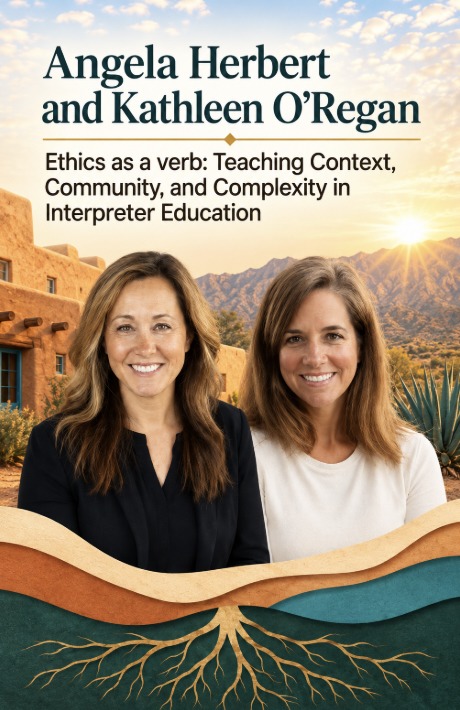
“Ethics as a verb: Teaching Context. Community, and Complexity in Interpreter Education “
Workshop Description:
Are we teaching students to follow ethical rules – or to reason through ethical complexity? This interactive seminar reframes ethics as an active practice grounded in context, community, and relational accountability. Drawing on the concept of situational terroir and the P³ + R² + G framework (Participants, Power, Privilege, Rights, Roles, Goals), participants will explore how shifting dynamics shape ethical decision-making in real-world assignments. The session connects Sankofa-informed historical reflection with context-driven analytical tools, positioning ethical reasoning as the bridge between foundational values and contemporary complexity. Through guided scenario analysis and curriculum reflection, educators will identify strategies for embedding ethical imagination into interpreter education programs. Participants will leave with a structured analytical template adaptable for classroom and mentoring use.
Educational Objectives:
Participants will be able to:
1) Analyze interpreting scenarios using the P³ + R² + G framework to identify contextual ethical variables.
2) Compare rule-based ethics instruction with context-driven ethical reasoning models.
3) Evaluate how professionalization influences ethical decision-making within interpreter education.
4) Develop instructional strategies that promote ethical imagination and relational accountability in students.
5) Integrate situational terroir analysis into case-study design and mentoring practices.
Bio:
Angela Herbert, EdM, NIC, is an Assistant Professor in the American Sign Language Program at Framingham State University, where she teaches across the interpreting curriculum, including Ethical Decision-Making in the Interpreting Profession, practicum courses, and advanced interpreting coursework. With over 17 years in interpreter education and professional experience in medical, community, and educational settings, she has mentored interpreting students since 2005 and contributed to curriculum development at both Framingham State University and Northeastern University. Her work centers on reflective practice, Deaf-centered decision-making, and preparing students to navigate complex ethical landscapes with contextual awareness and relational accountability. She is committed to advancing pedagogical approaches that bridge foundational values with contemporary professional realities.
Kathleen E. O’Regan, MA, NIC, is the Founder and Chief Executive Officer of KEO Solutions and Chief Operating Officer at Applied Development, where she leads mission-driven work focused on accessibility, communication access, operational strategy, and inclusive systems change. With more than 20 years of experience across interpreting, higher education, social entrepreneurship, reasonable accommodations, and organizational leadership, she has developed and led programs that strengthen equitable access for Deaf, DeafBlind, and hard of hearing communities. Her professional background includes founding Civic Access, serving as Coordinator of Deaf and Hard of Hearing Services at the University of Virginia, and teaching ethics and professional decision-making at Northeastern University. Her work centers on social impact, ethical leadership, Deaf-centered collaboration, and sustainable systems that improve communication access across workplaces, educational settings, and community-based organizations. She is committed to advancing practices that align operational excellence with equity, accountability, and meaningful inclusion.
RID CEUs Offered: .15