Workshop Title:
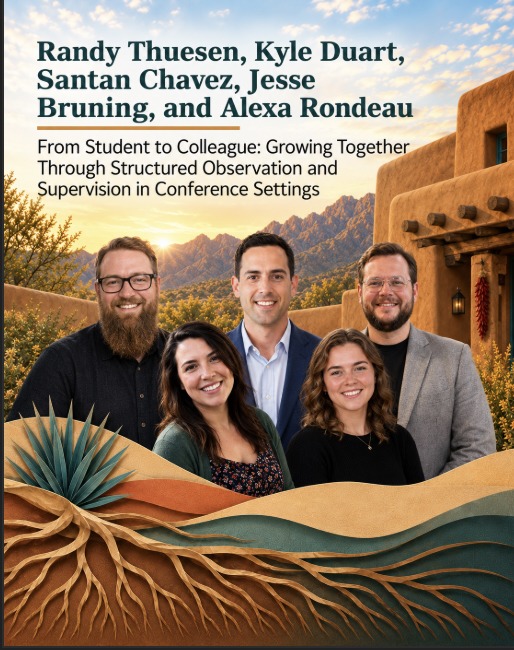
“From Student to Colleague: Growing Together Through Structured Observation and Supervision in Conference Settings”
Workshop Description:
(View in ASL – Click here)
What happens when interpreting students step out of the classroom and into a national professional conference, not as attendees, but as observer-participants embedded in a structured supervision model? This panel discussion presents findings from a qualitative case study examining how ASL-English interpreting students and professional interpreters experienced and envisioned structured supervision in a conference setting.
Drawing on focus group interviews and student reflection journals, preliminary findings reveal four key insights: observation is a developmental skill that evolves with the learner; structured observation tools scaffold novices but can constrain advanced students; cross-cohort peer debriefing creates powerful near-peer mentorship; and access to the full professional cycle, from prep to post-assignment debrief, is among the most transformative learning experiences students reported.
For interpreter educators, this study offers both a proof of concept and practical design principles for field experiences that bridge classroom learning and professional practice. Attendees will leave with a clearer picture of what structured conference supervision can look like and what institutional conditions make it possible.
This session connects directly to the conference theme: growing the next generation of interpreters means giving them real soil to grow in.
Educational Objectives:
After this workshop, participants will be able to:
1) Describe at least three design principles for implementing structured observation and supervision in a professional conference setting, including considerations for developmental stage and institutional alignment.
2) Identify key conditions that support professional formation in field-based interpreter education, including psychological safety, access to the full cycle of professional practice, and cross-cohort peer debriefing.
3) Apply a developmental framework for observation and supervision to their own interpreter education programs, distinguishing between scaffolding strategies appropriate for novice versus advanced interpreting students.
Bio:
Randy Thuesen brings a wealth of experience shaped by decades of connection with Deaf, DeafBlind, and Blind communities —a journey that began in his Texas childhood and has guided his career ever since. As the coordinator of the ASLEI program and Senior Lecturer at the University of Northern Colorado, Randy is known for his engaging teaching style, his commitment to creative and transformative interpreter education, and his passion for helping interpreters grow with purpose. Beyond his extensive professional background, Randy is grounded, relatable, and genuinely invested in the communities he serves. He and his wife now call Colorado home, where they enjoy exploring the state’s natural beauty (and are still chasing the chance to see the Aurora Borealis!).
Kyle Duarte is a sign language linguist, interpreter practitioner, and language access advocate based in Washington, DC. He earned a PhD in France, where his research examined the phonetic structure of signed languages through a computational linguistics lens. His scholarly background informs a practice deeply rooted in the linguistic and cultural complexity of signed language communities.
Kyle is the founder of The Kyle Duarte Company, a Washington, DC-based language services firm specializing in sign language interpreting and real-time captioning for academic and research clients. He holds BEI Master and NIC certifications and brings extensive experience interpreting in international contexts and supporting Deaf professionals across a range of settings.
Santana Chavez, NIC, is a certified signed language interpreter from rural New Mexico currently residing in Albuquerque — the 15th generation of her family to call this land home and the first to complete post-secondary education. She holds a B.S. in Communicative Disorders from Eastern New Mexico University (2013) and a B.S. in Signed Language Interpreting from the University of New Mexico (2016). After completing the Interpreter Apprenticeship Program at Rochester Institute of Technology, she returned home in 2019 to work as a freelance community interpreter. She specializes in complex settings including conference, legal, linguistics, and federal government interpreting. Most recently, she completed the Interpreter’s Lead International Sign training program. Santana also mentors students and interns from local and out-of-state interpreting programs. In her free time, she enjoys rock climbing, rafting, and cultivating her dye garden.
Jesse Bruning, known to many in the community by the sign name ‘JB’, is a Colorado native and dedicated aspiring interpreter. Currently in his second year of the ASL-English Interpretation (ASLEI) program at the University of Northern Colorado, Jesse is honing the skills necessary to provide competent communication access within the community. Since his introduction to the Deaf community 14 years ago, he has developed a deep passion for the language and culture. Jesse is committed to ethical standards and is eager to contribute to the field’s growth through continued professional development and community engagement.
Alexa Rondeau was born and raised in Michigan and moved to Colorado 3 years ago. She started an ASL-English Interpreting program at Madonna University and transferred to the University of Northern Colorado in 2023. She will graduate with an ASL-English interpreting degree in the spring of 2027.
RID CEUs Offered: .15