Workshop Title:
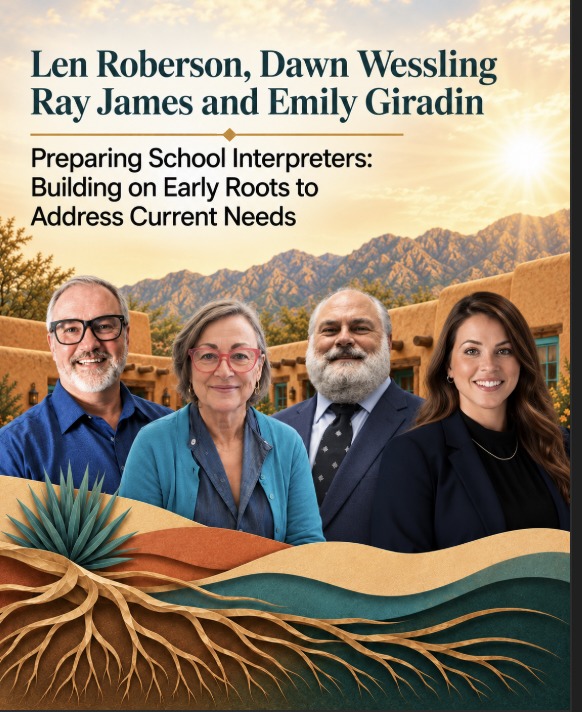
“Preparing School Interpreters: Building on Early Roots to Address Current Needs”
Workshop Description:
(View in ASL – Click here)
Through a panel discussion, participants will learn how three different OSEP grant-funded programs examined early, foundational research on interpreting in educational settings to develop preservice programs within existing academic interpreting degree programs that include specific knowledge sets and interpreting skills related to K-12 students.
Educational Objectives:
1) Describe three similarities and three differences between three OSEP-funded projects designed to increase the number of highly qualified educational interpreters in public schools.
2) Identify two challenges faced in the implementation and management of each of the three OSEP-funded projects designed to increase the number of highly qualified educational interpreters in public schools.
Bio:
Len Roberson is a program director of the ASL/English interpreting program at the University of North Florida, and an active researcher, interpreter, and interpreter educator. He is a certified Master Reviewer with Quality Matters, a certified Master Online Teacher, and has ACUE certification in Effective Teaching Practices. His current research interests include admissions screenings and curriculum and accreditation of interpreter education programs, and online teaching and learning. He is the current President of CCIE and editor for the Journal of Interpretation, published by RID.
Dr. Dawn M. Wessling has been working as a signed language interpreter for over 30 years and has been teaching interpreting and related topics in academic and workshop settings for 20+ years. She learned American Sign Language from the Deaf community while on active duty in the United States Navy and continues to have strong ties to the community. She serves as an Assistant Professor at the University of North Florida. Her research interests include attrition of interpreters, mentoring of interpreters and interpreting students, and language policy in interpreter education.
Ray James (NIC, IC/TC, BEI IV-Court Interpreter) has been coordinating OSEP grants since 1992, addressing the training of educational interpreters for the public-school systems. He is a native Texan and has been interpreting for 47 years. His array of interpreting experience includes intensive community interpreting, along with political/government, court/legal, mental health/12 step programs, educational K-12/postsecondary, and religious. Currently, much of his interpreting is Video Relay interpreting. He is one of the founding authors of the Certification Maintenance Program for the Professional Development Committee of RID; chaired the development of the Affiliate Chapter Handbook for RID; led the development and passing of the Arkansas Licensure Law for ASL/English Interpreters; and has been a trainer of ASL/English Interpreters for over 36 years.
Emily G. Girardin, Ed.D., Ed:K-12 – Dr. Girardin is a school interpreter, educator, researcher, and director of the Preparing School Interpreters Project (OSEP grant H325K210024, 2021–2026) at the University of Northern Colorado. With nearly 20 years of experience, she prepares future interpreters through an applied, interdisciplinary, systems-focused approach. She led the development of a 16-credit specialization, the School Interpreting Series, aligned with competencies for effective K–12 practice. She holds a Doctorate in Education: Mind, Brain, and Teaching from Johns Hopkins University. Her dissertation, “American Sign Language Fluency: A Foundational Competency for Future School Interpreters,” examined pre-service preparation of interpreters. She also co-authored Complexities in Educational Interpreting: An Investigation into Patterns of Practice (2nd edition). She regularly serves in roles supporting the National Association of Interpreters in Education and the Registry of Interpreters for the Deaf, and remains grounded in practice as a school interpreter.
RID CEU Offered: .15