Workshop Title:
“From Foundation to Fluency: Implementing A Three-Part Framework for Interpreter Excellence”
Workshop Description:
Building a competent interpreter requires more than conversational ASL fluency — it demands structured language development, specialized vocabulary, and ongoing professional growth. This workshop introduces interpreter educators to TWA Innovations’ three-part Deaf-authored framework for developing well-rounded interpreter practitioners. Beginning with TWA Textbook’s foundational ASL coursework — covering grammar, syntax, structure, and vocabulary — participants will explore how to establish strong linguistic footing before advancing to specialized domains.
From there, TWA Dictionary’s searchable, video-based ASL dictionary equips interpreters with community-validated signs across medical, legal, educational, and professional settings. Finally, TWA Academy rounds out the continuum with specialized ASL and interpreting content that program directors can embed directly into advanced courses — and CEU-eligible professional development for working interpreters beyond graduation. Grounded in Deaf authorship and linguistic accuracy, this framework gives interpreter education programs a clear, sequential pathway — from the classroom to the field. Participants will leave with practical strategies for integrating all three tools across their curricula and a renewed commitment to Deaf-centered interpreter preparation.
Educational Objectives:
By the end of this workshop, participants will be able to:
1) Describe how TWA Textbook’s foundational ASL curriculum supports the development of linguistically accurate and culturally grounded interpreter competency.
2) Identify how TWA Dictionary can be integrated into interpreter preparation to build specialized vocabulary across medical, legal, educational, and professional domains.
3) Design a program-level pathway using TWA Textbook, TWA Dictionary, and TWA Academy to support interpreter development from pre-service training through ongoing professional growth and CEU attainment.
Bio:
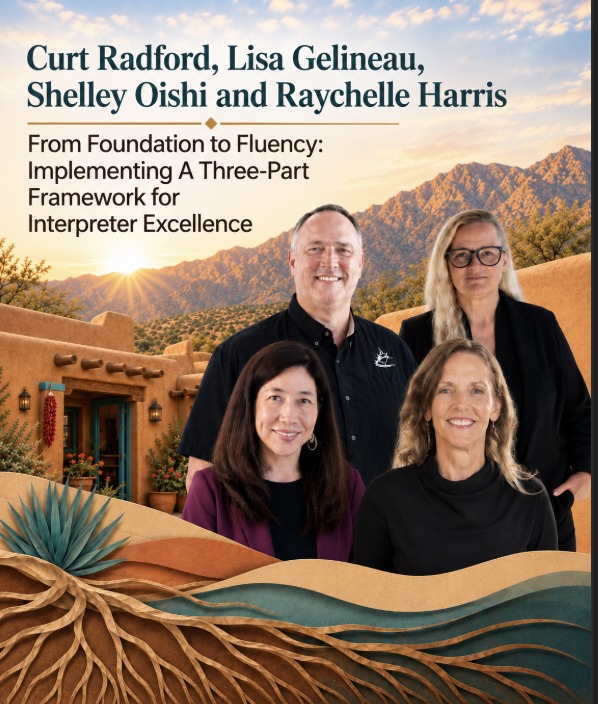
Dr. Curt Radford brings over 30 years of experience teaching and developing American Sign Language courses at the university level. A pioneer in online ASL education, he launched the first online ASL program at Utah State University in 2009 and most recently served as a professor at Idaho State University teaching ASL and Deaf Education. He holds a doctorate in Deaf Education/Deaf Studies from Lamar University, where his dissertation examined face-to-face versus online/hybrid ASL instruction. Dr. Radford has presented widely on effective ASL teaching strategies and the implementation of online ASL programs. He currently collaborates with TWA Innovations, providing training and workshops and supporting interpreter education programs seeking to integrate high-quality, structured ASL coursework. His expertise in program development, instructional design, and ASL pedagogy makes him a valued voice in the ongoing conversation about preparing competent, well-rounded interpreters.
Lisa Gelineau brings over 30 years of experience in ASL education, specializing in college-level instruction, ASL proficiency evaluation, and curriculum development — with particular attention to how language is taught, assessed, and applied in ASL and interpreting contexts. She holds a Master’s degree in Deaf Studies/Deaf Education from Lamar University, completed all doctoral coursework in Deaf Studies at Lamar University, and earned a Bachelor’s degree in Communication Studies from Texas State University. A co-founder and co-author of TWA Innovations since 2011, Lisa has helped develop one of the most comprehensive Deaf-authored ASL curricula available — providing interpreter education programs with linguistically grounded, research-based resources that build the strong ASL foundation interpreters need. As a full-time professor at Austin Community College’s ASL and Interpreter Preparation Program and recipient of ACC’s Teacher Excellence Award, Lisa brings firsthand experiences.
Shelley Oishi is the CEO of TWA Innovations, bringing a background spanning rehabilitation counseling, business development, and accessibility-focused program leadership to the work of advancing high-quality ASL educational resources. She holds a B.A. in Graphic Design from Rochester Institute of Technology and an M.S. in Rehabilitation Counseling from Western Oregon University. Her professional experience includes senior leadership roles at Communication Service for the Deaf and Purple Communications, where she led large teams, built strategic partnerships, and supported accessibility initiatives across education, government, and nonprofit sectors — including initiatives directly serving interpreter education and training communities. At TWA Innovations, Shelley oversees the strategic development and delivery of TWA Textbook, TWA Dictionary, and TWA Academy, ensuring these tools meet the practical and academic needs of interpreter education programs. She is committed to building resources that respect linguistic accuracy, community knowledge, and the standards that rigorous interpreter preparation demands.
Raychelle Harris, PhD, is a Deaf ASL educator, author, and co-owner of TWA Innovations, where she provides academic leadership for TWA Textbook, TWA Dictionary, and TWA Academy. She holds a PhD in Education with an emphasis in linguistics, with expertise in ASL teaching methods, sign language assessment, and the linguistic foundations that underpin effective interpreter preparation. For over a decade, Raychelle established, built, and led the world’s only Master’s program in Sign Language Education at Gallaudet University — defining global standards for sign language teacher preparation, curriculum design, and language assessment grounded in Deaf-led knowledge and expertise. She brings a strong background in research and research ethics, having taught graduate research courses, chaired dissertation committees, and published on ethical practices in Deaf-centered contexts. At TWA Innovations, she ensures that ASL educational resources meet the rigorous linguistic and academic standards that interpreter education programs demand.
RID CEUs Offered: .15