Workshop Title:
“The Three R’s of Role-Space and the Received Interpreter: Implications for Teaching Interpreter Decision-Making Strategies in Educational Environments”
Workshop Description:
The role of the signed language interpreter is a topic that has been frequently discussed and re-framed over the decades since the profession was formalized in the 1960’s. Role-Space (Llewellyn-Jones & Lee, 2014) contextualizes the interpreter role as an interactive and ever-shifting enactment of behaviors based on conventional expectations of certain statuses of a person in a given setting. Drawing on work from an ethnographic case study of educational interpreters in Italy (Crudo, 2025), this interactive seminar will discuss three primary concepts that guide interpreters’ work (Role, Responsibility, and Relationship), and will provide attendees the opportunity to apply Role-Space as a framework to analyze educational interpreting scenarios.
Grounding discussion in the context of Role, Responsibility, and Relationship, attendees will also discuss the impact of the Received Interpreter (Crudo, 2025) as a concept of what new interpreters often believe an interpreter should be. The seminar will close with a discussion of how Role-Space can benefit interpreting students as they develop critical decision-making strategies.
Educational Objectives:
1) Participants will be able to describe and define the Role-Space and the three guiding concepts of Role, Responsibility, and Relationship (the Three R’s) as they relate to interpreting.
2) Participants will apply Role-Space as an analytical tool to assess interpreters’ decisions and describe how the Three R’s occur in various example scenarios.
3) Participants will discuss the implications of the Three R’s and Role-Space as an analytical framework for understanding the impacts of interpreter decision-making in collaborative educational environments.
4) Participants will be able to define the concept of the Received Interpreter and describe how it manifests in their own interpreter education programs.
5) Participants will collaboratively devise and discuss methods of how to integrate Role-Space into interpreter education programs as a tool for students to utilize in their own decision-making processes.
Bio:
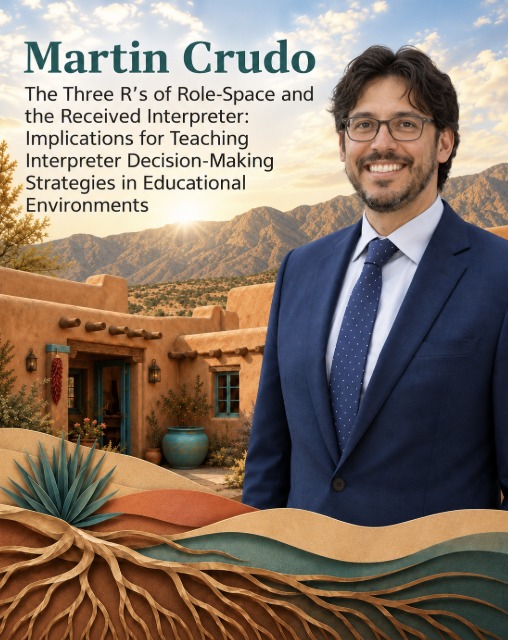
Dr. Martin A. Crudo is an Assistant Professor in the ASL & Deaf Studies Program at Sacramento State University and is a certified hearing interpreter (NIC) with the Registry of Interpreters for the Deaf. His research focuses on interpreter role-space (Llewellyn-Jones & Lee, 2014) in educational settings. In particular, he applies role-space as an analytical framework to investigate interpreter decisions and collaborative techniques.
His dissertation applied role-space in an ethnographic case study of interpreters in a dual language program in an Italian public elementary school (Crudo, 2025). In addition to teaching at Sacramento State, he also continues to interpret in various community and virtual settings.\
RID CEUs Offered: .15