Workshop Title:
“Absolution and Mutual Aid in Interpreting”
Workshop Description:
This presentation explores interpreting through the principles of ableism, abolition, and access ecologies. I deploy Talila Lewis’s living definition of ableism, a system that assigns values to bodies and minds based on intersectional violences of eugenics, anti-Blackness, misogyny, and capitalism. We will explore abolition as a praxis of dismantling violent carceral systems to make space for new opportunities to flourish, such as mutual aid. Lastly, I develop the concept of access ecologies: multiple complex practices, relationships, and ways of being as interpreters.
This work builds on the work of abolitionist organizations like HEARD and the essays of DeafBlind author John Lee Clark to challenge partnerships between sign language adjacent organizations and oppressive systems. Feminist disability studies approaches require a critical look at systemic issues including carcerality, power, race, and ableism.
Aligned with the conference themes of Roots to Radiance, this work digs deep into systemic barriers and how, as interpreter practitioners, we may support or subvert systems of inequity we work within every day. We are being asked to meet this moment and must contend with the profession’s fallacy of neutrality. This session is not intended to give answers but open and develop conversations for new directions within the field.
Educational Objectives:
1) Define the framework of ableism through Talila Lewis’s working definition of ableism as systemic inequity says some body/minds are worthy and valuable while others are not. Understand that ableism does not only harm disabled people.
2) Describe the foundations of ‘what comes next’ after abolition; exploring mutual aid practices and what it might look like to go back to the roots of interpreting as a relational practice.
3) Explain at least three of the multiple perspectives on access through the framework of access ecologies and begin to imagine liberatory futures through the relational practice of sign language.
Bio:
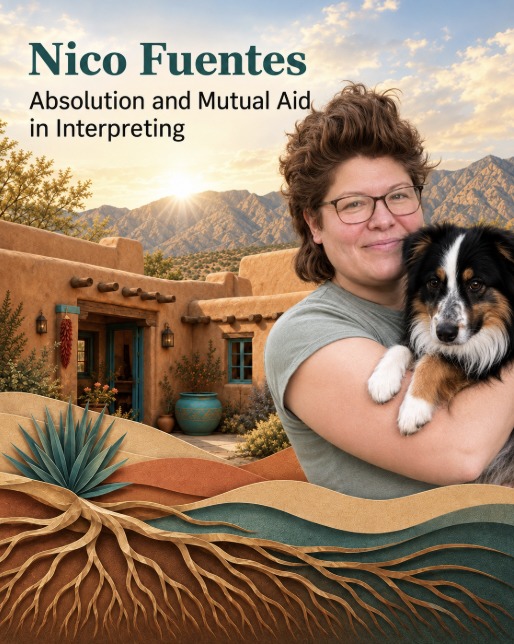
Nico Fuentes (they/them; hearing) is a disabled ASL-English interpreter and PhD student in Women’s, Gender, and Sexuality at Ohio State University in Columbus, Ohio. With a passion for linguistics and disability justice, their research interests converge at the intersections of sign language interpreting, crop and Black studies. Fuentes has previously served as a staff member at a rape crisis center. In this role, they facilitated empowerment support groups with survivors who were incarcerated and provided sex education to ages 4-18 in schools as a form of youth sexual assault prevention. They also served as a board member for DWAVE (Deaf World Against Violence Everywhere) from 2022-2024 and continue to fight against gender-based violence wherever possible. In their free time, they’re often at home cooking and eating or in the woods chasing wildflowers and their little dog, Roo.
RID CEUs Offered: .15