Workshop Title:
“Two to Interpret: Teaching the Full Spectrum of Interpreter Teaming Through a Unified Framework”
Workshop Description:
(View in ASL – Click here)
Interpreter teaming is a professional expectation that is rarely a curricular priority. This hands-on workshop offers interpreter educators a unified framework for teaching teaming across the full range of configurations: hearing-hearing, Deaf-hearing, Deaf-Deaf, CDI-CHI, and beyond. Presenters Michael J. McMahon and Sharon Neumann Solow bring more than 70 combined years of professional experience and have teamed together, making this more than a theoretical discussion. Participants will examine the shared roots of effective teaming, explore how those roots branch into configuration-specific competencies and challenges, and practice using concrete classroom tools including an adaptation of the Stop-Light Assessment Framework for evaluating team readiness. Come prepared to work and leave with something you can use immediately.
Educational Objectives:
1) Identify the core teaming competencies shared across all interpreter team configurations, including coordinated decision-making, mutual monitoring, role negotiation, and co-construction of a unified interpretation.
2) Distinguish how teaming dynamics, communication norms, and role expectations differ across hearing-hearing, Deaf-hearing (CDI/CHI), Deaf-Deaf, and DeafBlind team configurations, and explain the specific pedagogical implications of each.
3) Apply the Stop-Light Assessment Framework as a team-readiness tool in classroom and practicum settings, guiding student teams to honestly evaluate their collective readiness before, during, and after interpreted events, and to identify concrete support strategies for Yellow-light configurations.
4) Analyze teaming breakdowns and successes using a shared analytical framework that can be applied across configurations in classroom and practicum settings.
5) Design at least one curricular activity or assessment that teaches and measures a specific teaming competency appropriate for their program level and student population.
6) Describe strategies for preparing interpreter students to discuss teaming decisions in ASL with Deaf colleagues and CDI partners, rather than defaulting to English-based debriefs.
Bio:
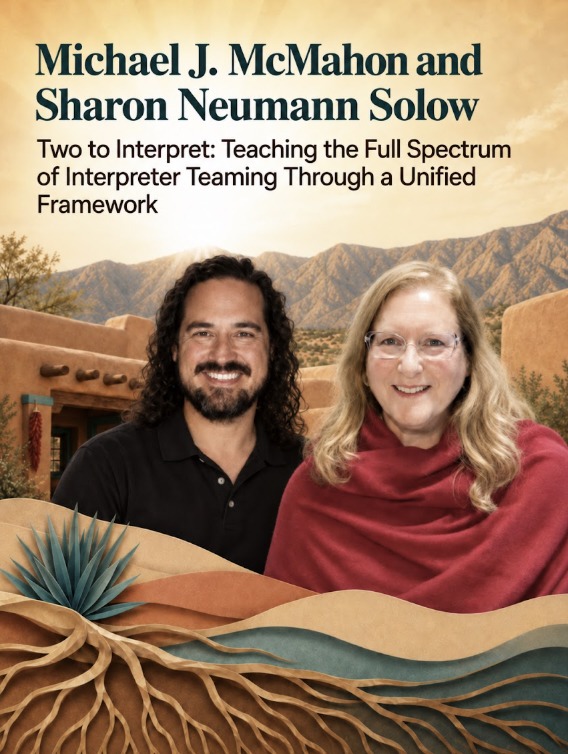
Michael J. McMahon, RID:CDI, BEI:CIC, is a Certified Deaf Interpreter and Court Interpreter Certified professional based in the Bay Area, California, with over 15 years of experience across legal, conference, high-tech, community, and performing arts settings. As a graduate of the Interpreter Education Program at the University of Arkansas at Little Rock, where he became the first Deaf student to earn a Bachelor of Arts in Interpretation: ASL/English, he brings firsthand knowledge of what interpreter trainers teach and what students actually experience in IEP classrooms. The first CDI certified in Arkansas, Michael specializes in court and legal interpreting, platform and conference work, DeafBlind interpreting, and translation. He has presented regionally and nationally on teaming, ethics, and legal interpreting, and serves on the Ohlone College Deaf-Centered Interpreting Preparation Program Advisory Board. He has previously co-presented with Sharon Neumann Solow on Deaf-hearing teaming in virtual settings.
Sharon Neumann Solow, MA, CSC, SC:L, is an interpreter, educator, author, consultant, and performer with more than 60 years of experience in the field. She is the author of three books, including Sign Language Interpreting: A Basic Resource Book and Powerful Interpreting: Build Your Skills in 5 Steps, and has lectured and trained interpreters across the United States and internationally. A long-standing member of both RID and CIT, she holds the RID Specialist Certificate: Legal and the NAD SIGN Comprehensive Permanent Certificate. She is the 2010 recipient of the joint RID-CIT Mary Stotler Award and was recognized with the RID President’s Award in 2005 as well as NAOBI’s President’s award the same year. Her practice spans legal, conference, community, and theatrical interpreting, and she has extensive experience working in and teaching Deaf-hearing and international interpreter teams.
RID CEUs Offered: .15